Sectional Sofa Buying Guide: Sizes, Configurations and Real Costs
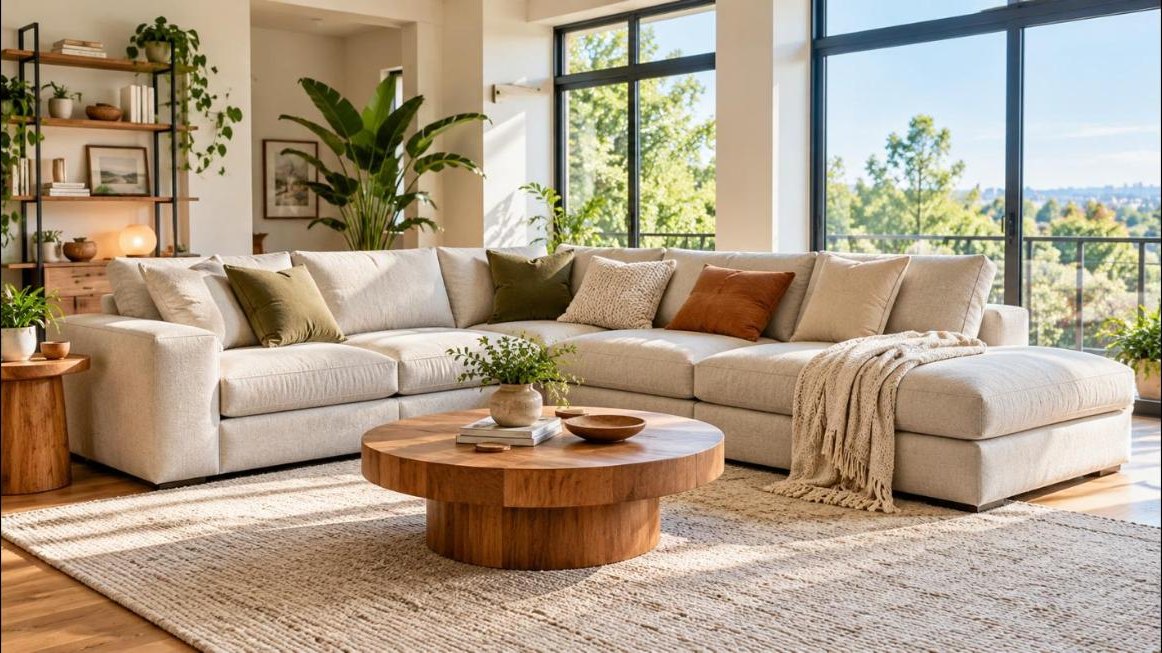
A sectional is the single biggest piece of furniture most people will ever buy for a living room, and it is also the one most likely to be sent back. The returns are rarely about taste. They are about a sofa that blocked a doorway, a chaise that ended up on the wrong side, or a frame that sagged within a year. This guide walks through the three decisions that matter most: size, configuration and build quality.
Start with the room, not the sofa
Measure three things before you look at a single listing. First, the wall or floor area the sectional will occupy, including the space you need to walk past it. Leave at least 30 inches of clear walkway on any route people actually use, and 14 to 18 inches between the front of the seat and a coffee table. Second, the delivery path: front door width, hallway turns, stairwell landings and any low ceiling on the way. Third, the ceiling height and window line, because a high-back sectional in a room with low windows makes the whole space feel shorter.
A quick trick that costs nothing: mark the footprint on the floor with painter tape and live with it for two days. You will discover the traffic problem before the delivery truck does.
Standard sectional sizes
Most sectionals fall into a handful of footprints. A two-piece L-shape for a small room typically runs about 84 to 95 inches along the long side and 60 to 65 inches on the short return. A standard family L-shape sits around 105 to 120 inches by 80 to 90 inches. A U-shape or pit sectional usually needs at least 120 inches of wall and about 110 inches of depth, which rules it out for most apartments.
Seat depth matters more than overall depth. A 21 to 23 inch seat suits shorter people and formal rooms. A 24 to 27 inch seat is the comfortable middle. Anything past 28 inches is a lounging sofa and will feel awkward for sitting upright with a laptop or a plate.
Configurations: chaise, corner, modular
A chaise sectional has one extended seat without a back on the short arm. It is the lightest-looking option and the easiest to fit in a small room, but only one person can stretch out.
A corner sectional uses a full square corner seat, so both arms are usable seating. It eats more floor area but adds genuine capacity.
A modular sectional ships as separate seats that clip or bracket together. You can reconfigure it after a move, and you can usually buy extra seats later. The trade-off is visible seams and a tendency for pieces to drift apart on hard floors unless the connectors are good metal brackets rather than plastic clips.
Handedness confuses almost everyone. In the industry, left-facing and right-facing are described from the point of view of someone sitting on the sofa looking out into the room. If the chaise is on your left while you sit, it is a left-arm-facing chaise. Confirm this in writing before ordering, because a wrong-hand sectional is usually not returnable without a restocking fee.
What each price tier actually buys
Under roughly 800 dollars you are generally looking at engineered wood or particleboard frames, sinuous spring or webbed support, and polyester covers over polyurethane foam of modest density. These can look good for two or three years in a low-use room, but they are rarely worth reupholstering.
In the 1,000 to 2,500 dollar range you start seeing kiln-dried hardwood frames, eight-way hand-tied or high-gauge sinuous springs, and foam with a density around 1.8 to 2.2 pounds per cubic foot wrapped in a down or fibre layer. This is where most households should aim.
Above 3,000 dollars the gains are in materials and labour: full hardwood frames with corner blocking and screws rather than staples, higher-density foam or spring-down cushions, performance or top-grain leather covers, and the ability to order a custom size or cover. Durability improves, but the curve flattens.
The specifications worth asking about
- Frame: kiln-dried hardwood with corner blocks beats plywood, which beats particleboard.
- Joinery: doweled, screwed and glued joints last; staples alone do not.
- Suspension: eight-way hand-tied is the traditional premium; heavy-gauge sinuous springs are fine and far more common.
- Cushion fill: ask for foam density. Below 1.8 pounds per cubic foot it will flatten quickly.
- Cover: ask for the double rub count. Over 15,000 is residential-durable; over 30,000 is heavy duty.
- Reversible cushions: they double the life of the seating surface.
Common mistakes
Buying the largest sectional that technically fits is the most expensive mistake, because it kills circulation and makes the room feel like a waiting area. Ignoring the depth of the back cushions is the second: a 40 inch total depth sectional against a window will cut the light. Choosing a very light cover without a removable, washable option is the third, particularly with children or pets.
Finally, order fabric swatches. Screen colour is unreliable, and a grey that reads warm in a showroom can read purple under your own lighting.
A simple decision path
If your room is under 12 feet wide, take a chaise sectional with a 23 to 25 inch seat depth. If you have 14 feet or more and you entertain, take a corner configuration. If you expect to move within three years, take a modular model with metal connectors. In every case, spend the marginal money on the frame and the foam rather than on the cover, because the cover is the one part you can realistically change later.

Written by gautam995576@gmail.com
Furniture buying editor focused on practical room planning, material checks, and clear decision guidance.
Related furniture guides
How to Choose a Sofa for Your Space and the Way You Live
A practical, no-jargon guide to choosing a sofa that fits your room, your routine, and your life, covering size, comfort, fabric, and…
Sectional vs Regular Sofa: Which One Actually Suits Your Living Room
Sectional or a regular sofa? A clear comparison of how each works in small, large, and open-plan rooms, so you pick the…
Coffee Table Ideas: Getting the Size, Shape, and Styling Right
How to choose and style a coffee table that fits your seating and space, with practical advice on size, shape, height, storage,…