Sleeper Sofas and Futons: An Honest Comfort Comparison
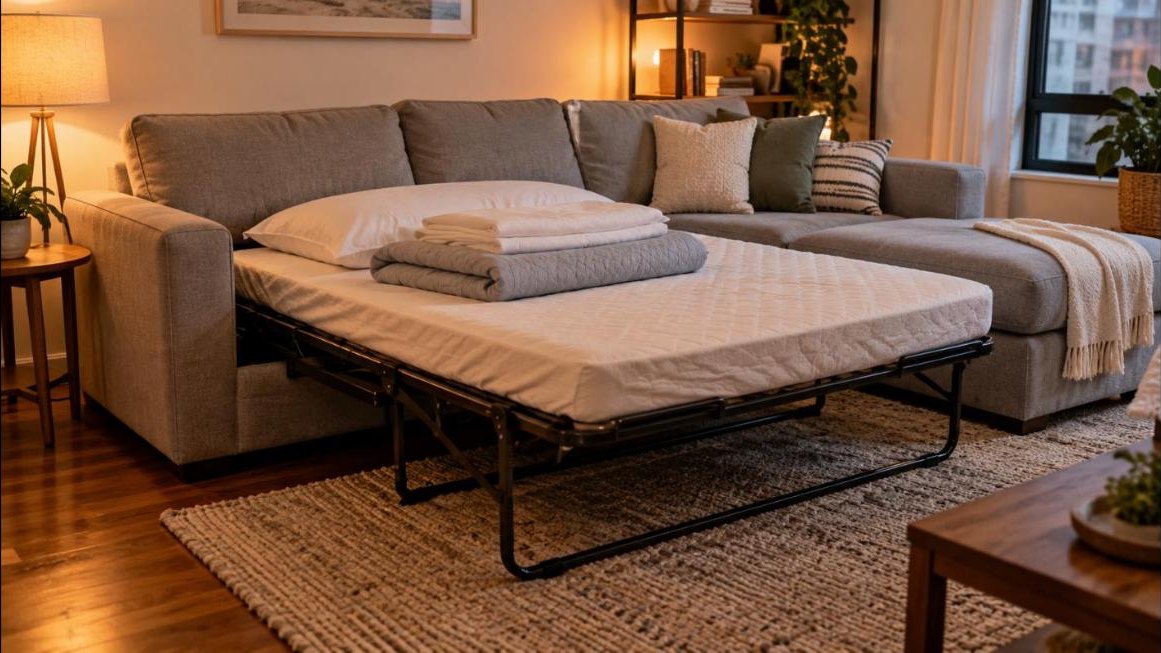
Nobody buys a sleeper sofa because they love sleeper sofas. They buy one because a spare bedroom is not an option and guests still need somewhere to sleep. The useful question is not which type is best in the abstract, but which compromise you can live with for the 360 nights a year when nobody is sleeping on it.
The three formats
A pull-out sleeper hides a folding metal frame and a thin mattress inside a conventional sofa. It sits like a sofa because it is one, and it sleeps like a bed with a bar under it, because that is also true.
A futon or click-clack is a single cushion on a hinged frame that drops flat. It sleeps as one continuous surface with no bar, and it sits more upright and firmer than a sofa.
A daybed or trundle is a real mattress on a frame with a back and arms. It sleeps best of the three and sits worst, because you are essentially sitting sideways on a bed.
How they actually sleep
The honest ranking for an adult guest over several nights is daybed, then futon, then pull-out. The pull-out loses because of the support bar that runs across the frame under the hips, and because the mattress has to fold, which caps its thickness at around four to six inches on most models.
Two upgrades change the maths. An air-over-coil or gel memory foam sleeper mattress, typically a 200 to 400 dollar upgrade, lifts a pull-out from unpleasant to acceptable. A three-inch foam topper, which costs much less, does about two-thirds of the same job and can be stored in a closet. If you expect guests more than a handful of nights a year, one of these is not optional.
Futons sleep flat and even, which sounds better than it is. Thin futon mattresses bottom out on the frame slats, and the fold line develops a permanent crease within a year or two. Look for a mattress at least eight inches thick with a pocket-coil or high-density foam core, and a frame with slats no more than three inches apart.
How they actually sit
This is where the ranking inverts. A good pull-out is indistinguishable from an ordinary sofa when closed, apart from being heavier and usually a little firmer at the front edge. A futon sits upright with a shallow seat and almost no lumbar shape, which is fine for twenty minutes and tiring for a film. A daybed forces you to either sit on the edge like a bench or lean against the wall with cushions.
If the piece lives in your main living room and you use it daily, the pull-out is the only one of the three that will not annoy you.
Weight, mechanism and the floor
A queen pull-out weighs between 150 and 250 pounds. That matters for upstairs delivery, for moving house, and for hardwood floors. Check that the frame has felt or rubber feet, and never drag a sleeper across a wood floor.
The mechanism is the part that fails. Look for a steel frame rather than aluminium, a smooth single-motion pull, and a brand that publishes replacement part availability. Click-clack futons fail at the hinge; the cheap ones use stamped steel plates that bend out of alignment after a few hundred cycles.
Space and clearance
A queen pull-out needs roughly 80 to 90 inches of clear floor in front of the sofa when open. Measure this before buying, because an open sleeper that blocks the only door is a safety problem, not just an inconvenience. A futon needs clearance behind it instead, usually six to ten inches, so it cannot sit flush against a wall. A daybed needs nothing extra, which is one of its real advantages in a very small room.
Cost of ownership
Budget futons start around 250 dollars and genuinely are disposable. Mid-range futons at 500 to 900 dollars with a coil mattress will last several years. Pull-out sleepers start realistically around 800 dollars and run to several thousand; the sub-600 dollar sleepers almost always pair a weak frame with a two-inch mattress and are worse than a good air bed. Daybeds are the cheapest route to a comfortable guest bed, often 400 to 800 dollars including a real twin mattress.
Add the hidden costs: a mattress upgrade or topper, sheets in an odd size for pull-outs, and in some cases a second person to help open it.
Who should buy which
- Guests a few times a year, sofa used daily: a mid-range pull-out plus a foam topper.
- Home office that doubles as a guest room: a daybed with a trundle, which gives two real beds and a reading spot.
- Studio apartment, tight budget, light use: a quality futon with a coil mattress, not the cheapest one.
- Frequent long-stay guests: stop compromising and buy a proper air-over-coil sleeper or a wall bed.
Before you order
Ask for the open dimensions as well as the closed ones, confirm the mattress thickness and type, check the doorway and stair path for the weight, and read the warranty specifically for the mechanism rather than the fabric. A sleeper that is comfortable to sit on and tolerable to sleep on is achievable. A sleeper that is excellent at both is not, and any listing that claims otherwise is selling you the photograph.

Written by gautam995576@gmail.com
Furniture buying editor focused on practical room planning, material checks, and clear decision guidance.
Related furniture guides

Sectional Sofa Buying Guide: Sizes, Configurations and Real Costs
How to pick a sectional that actually fits your room: standard sizes, chaise vs corner configurations, what each price tier buys you,…
How to Choose a Sofa for Your Space and the Way You Live
A practical, no-jargon guide to choosing a sofa that fits your room, your routine, and your life, covering size, comfort, fabric, and…

Sectional vs Regular Sofa: Which One Actually Suits Your Living Room
Sectional or a regular sofa? A clear comparison of how each works in small, large, and open-plan rooms, so you pick the…