Good Sofas Under $1000: What You Can Reasonably Expect

A thousand dollars is an awkward budget for a sofa. It is well above the disposable flat-pack tier and well below the point where hardwood frames and hand-tied springs are standard. Spent carefully, it buys a sofa that will look good for five to eight years. Spent carelessly, it buys two years and a sagging seat.
What gets cut at this price
Manufacturers have to save money somewhere, and the savings are predictable. In rough order of how often they appear:
- Frame material. Kiln-dried hardwood is replaced with plywood, engineered wood or, at the bottom, particleboard.
- Joinery. Doweled and corner-blocked joints become stapled butt joints.
- Cushion fill. Foam density drops from around 2.0 to 1.3 or 1.5 pounds per cubic foot.
- Suspension. Sinuous springs become elastic webbing, or the spring gauge gets thinner.
- Cover. Lower double rub counts and non-removable cushion covers.
- Finish details. Visible staples, uneven seam allowance, legs that screw into a plastic insert.
You cannot avoid all six. The goal is to make sure the cuts land on things you can live with rather than on the frame and the foam.
The specifications worth defending
If the listing tells you nothing else, push for these three.
Foam density of at least 1.8 pounds per cubic foot. This single number does more for perceived quality over time than anything else at this budget. Low-density foam compresses permanently, and once a seat has a dip the sofa reads as old regardless of how clean the cover is.
A plywood frame at minimum, never particleboard. Multi-ply hardwood plywood is genuinely acceptable and is used in some good mid-range furniture. Particleboard fails at the screw holes and cannot be repaired.
Removable, zippered cushion covers. This is the difference between a stain being a cleaning job and a stain being the end of the sofa.
Where the good value sits
Three categories consistently over-deliver under a thousand dollars.
Smaller sofas from quality makers. A 72-inch loveseat from a brand whose full-size sofas cost 1,800 dollars is often built to the same standard and lands inside budget. If your room allows it, this is the highest-quality route.
Floor models and open-box. A showroom sofa that has been sat on for three months carries a 30 to 50 percent discount and is otherwise new. Inspect the frame corners and the cushion recovery, and check that all original legs and hardware are included.
Modular direct-to-consumer sofas. Shipping in boxes removes a large cost, and several brands put that money back into the frame. The seams are more visible and the look is more casual, but the build is often better than a traditional sofa at the same price.
Where the value is not
Very large sectionals under a thousand dollars are almost always built down to the number, with thin foam spread over a big area that makes the compromise obvious fast. Reclining sofas at this price pair a cheap frame with a cheap mechanism, and the mechanism fails first. Anything described as bonded leather or faux leather at this budget will crack and peel, usually between years two and four.
A five-minute in-store test
- Lift one front corner a few inches. A good frame lifts as one piece; a weak one twists and the opposite leg stays down.
- Press hard into the seat and release. The foam should rebound within a second or two.
- Sit at the very front edge. If the frame rail digs in, the padding over the rail is too thin.
- Push the back. It should not flex more than slightly.
- Tip it and look underneath. You want a stapled dust cover you can peek past, webbing or springs in an even grid, and no raw particleboard edges.
Buying online without seeing it
Read the one and two star reviews only, and filter for the words sag, squeak, lean and flatten. Check the return policy for who pays return shipping on a large item, because a free returns policy that excludes oversized furniture is not a returns policy. Order fabric swatches. And confirm assembly: bolt-on legs are fine, but a sofa that requires the back to be fastened to the base with cam locks will never be as rigid.
Making it last
Rotate and flip reversible cushions monthly. Keep it out of direct sunlight. Vacuum the crevices, because grit acts like sandpaper on the weave from the inside. Tighten the leg bolts twice a year. And when the foam eventually goes, a replacement foam core cut to size costs a fraction of a new sofa and is a genuinely worthwhile repair if the frame is still sound. That last point is the real test of a budget purchase: a sofa worth repairing was a good buy.

Written by gautam995576@gmail.com
Furniture buying editor focused on practical room planning, material checks, and clear decision guidance.
Related furniture guides

Sofa Fabric Guide: Materials That Survive Real Life
Performance polyester, linen, velvet, chenille, leather and bouclé compared on durability, cleanability, pet resistance and how each one ages.
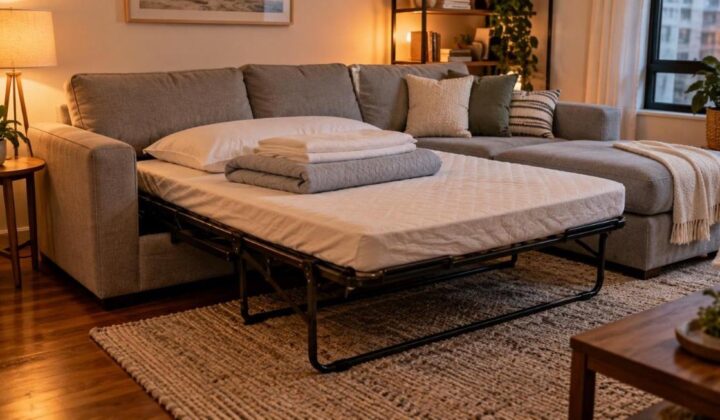
Sleeper Sofas and Futons: An Honest Comfort Comparison
Pull-out sleeper, click-clack futon or a daybed? A frank look at how each one sleeps, how each one sits, what they cost…

Sectional Sofa Buying Guide: Sizes, Configurations and Real Costs
How to pick a sectional that actually fits your room: standard sizes, chaise vs corner configurations, what each price tier buys you,…