Recliner Sofas: Manual vs Power and What Actually Breaks
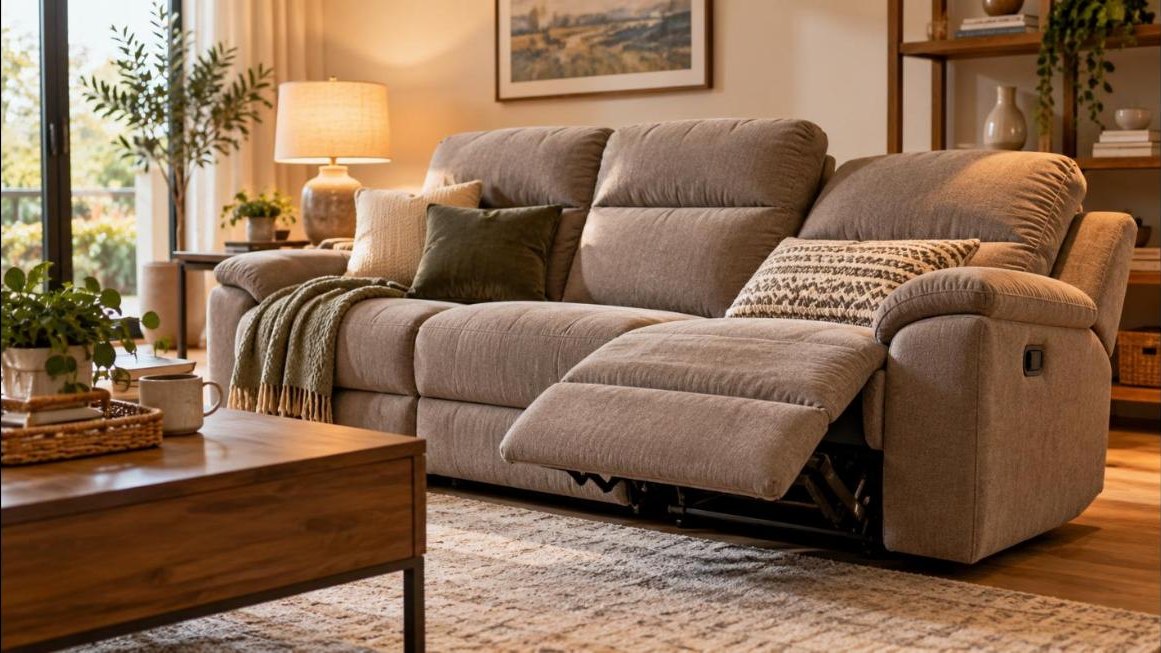
Reclining sofas are bought for comfort and returned for reliability. The upholstery on a recliner is rarely the problem. The mechanism is, and the mechanism is the part least described in product listings.
How the two types work
A manual recliner uses a lever or a push-back action against a steel linkage and a spring. There is no electronics, no motor and no power supply. Fewer parts means fewer failures, and a bent linkage can often be straightened or replaced cheaply.
A power recliner uses a small electric motor driving the same kind of linkage, controlled by a switch or a button panel. It stops at any position rather than at two or three fixed stops, it needs no physical effort, and it usually offers extras such as a powered headrest, lumbar adjustment or USB charging.
What actually breaks
In rough order of frequency:
- The handle or lever on manual models. Plastic handles snap. Metal handles bend. Both are usually replaceable for a modest amount if the manufacturer stocks parts.
- The power transformer. This is the brick between the wall socket and the sofa. It is the most common power failure and also the cheapest to replace, often 30 to 60 dollars. Before assuming a motor has died, test the transformer.
- The switch or button pad. Second most common on power models, and again inexpensive.
- The motor. Less common than people expect, but expensive and sometimes model-specific.
- The steel linkage. Fails from overloading, from children treating the footrest as a step, or from thin gauge steel on budget models.
- The frame around the mechanism. On cheap recliners the mechanism is bolted into engineered wood, which eventually tears out. This is the failure that ends the sofa.
Notice that most of the common failures on power models are cheap parts. The argument that manual is more reliable is true in terms of failure count, but the repairs on both are usually minor if parts are available. Parts availability is therefore the question to ask, not manual versus power.
Which to choose
Choose manual if the sofa will sit away from an outlet, if children will use it unsupervised, if you want the simplest long-term ownership, or if budget is tight. Manual models typically cost 200 to 500 dollars less for the same build quality.
Choose power if anyone using it has limited strength or mobility, if you want infinite position control, if you want a powered headrest for watching television, or if the sofa is heavy and the manual lever requires real effort.
For users with mobility issues, power is not a luxury. The physical motion needed to operate a manual lever while seated is exactly the motion that becomes difficult, and this is the one case where the choice is clear.
Wall-hugger designs and clearance
A conventional recliner needs 12 to 18 inches of clearance behind it to recline fully. A wall-hugger or zero-wall mechanism slides the seat forward as the back tilts, needing only 3 to 6 inches. In most rooms, especially apartments, this is the difference between a recliner that fits and one that does not.
Check the clearance figure before buying, and measure it in the room with the skirting board accounted for. Also check the forward footprint when open, which on a three-seat reclining sofa can be 70 inches or more from the back.
What to inspect
- Mechanism brand. Named mechanism suppliers publish parts catalogues. An unbranded mechanism usually means no parts in three years.
- Steel gauge. Heavier is better. Lift the footrest and feel for flex.
- Mounting. The mechanism should bolt into hardwood or multi-ply, not particleboard.
- Cycle rating. Good manufacturers test to a stated number of cycles, often 25,000 or more.
- Warranty split. Read the mechanism and motor warranty separately from the frame warranty. A lifetime frame warranty with one year on the mechanism tells you where the risk is.
- Battery backup. On power models, a backup pack lets you lower the footrest in a power cut. Without it, you are stuck reclined.
Living with one
Do not sit on the footrest and do not let anyone use it as a step; that is the main cause of linkage damage. Keep the mechanism free of crumbs and pet hair, and vacuum underneath every few months. Lubricate the pivot points with a dry PTFE spray once a year, not with oil, which attracts dust. On power models, keep the transformer off carpet where it can overheat, and unplug during electrical storms.
The comfort trade-off nobody mentions
A reclining sofa is almost always less comfortable than a normal sofa when upright, because the mechanism dictates the seat geometry and the back is split into discrete sections. The seat is often shorter and the lumbar support flatter. If you spend most of your sofa time sitting rather than reclining, consider a standard sofa plus a separate recliner chair. It costs similar, each piece does its job properly, and you can replace one without the other.

Written by gautam995576@gmail.com
Furniture buying editor focused on practical room planning, material checks, and clear decision guidance.
Related furniture guides

Living Room Furniture Sets: Buy Together or Build Separately?
Matching sets are cheaper and faster but can look flat and age as a unit. Here is when a set makes sense,…

Narrow-Depth Sofas for Tight Spaces: What to Look For
Sofas under 33 inches deep solve apartment layouts, but only if the seat depth and back angle are right. Here is how…

Styling a Grey Sofa: Colours That Lift the Room
Grey sofas go flat easily. Here is how to identify your grey undertone and build a palette around it with accent colours,…