Rug Buying Guide: Sizes, Materials and Placement
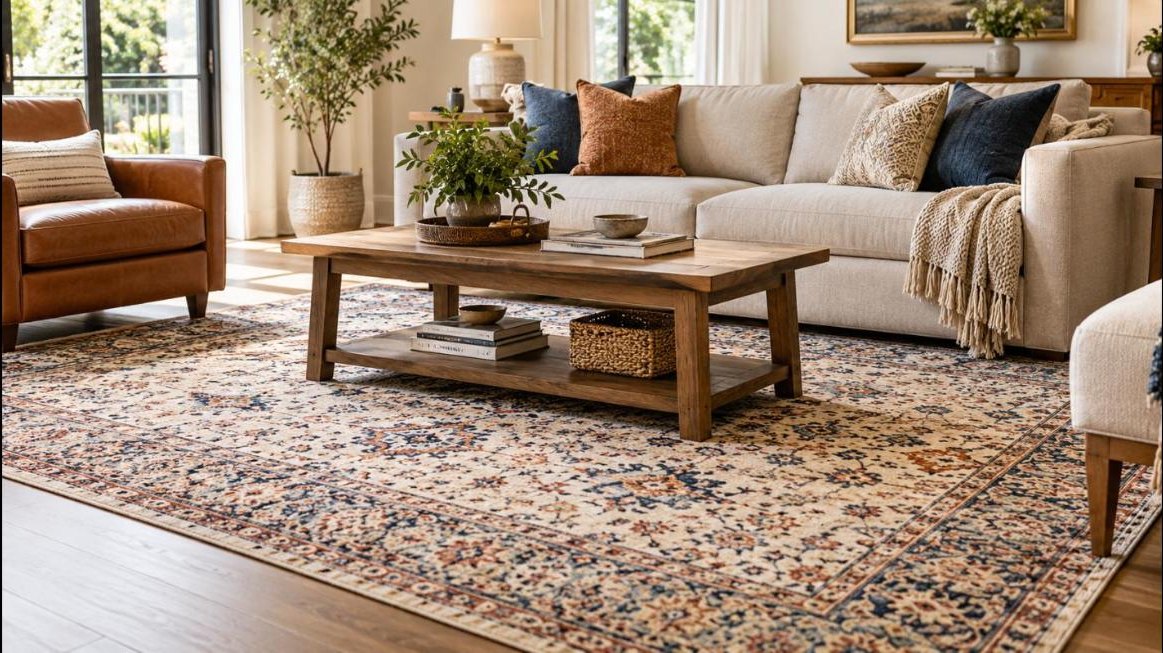
A rug is the cheapest way to change how a room feels and the easiest thing to get wrong. Almost every rug mistake is a size mistake: a rug too small makes the furniture look like it is floating around a postage stamp and makes the whole room read smaller.
Sizing by room
Living room. Three valid approaches. All legs on, where every piece of furniture sits fully on the rug, needs the largest size and looks the most luxurious. Front legs on, where the front legs of the sofa and chairs sit on the rug and the back legs are off, is the most common and most forgiving. All legs off, with the rug floating in the middle, only works in a very large room and usually looks like an error elsewhere.
In practice: a 5 by 8 foot rug is too small for almost any living room. An 8 by 10 is the minimum for a typical room. A 9 by 12 suits most standard living rooms. Large open-plan spaces need 10 by 14 or larger.
Dining room. The rug must extend at least 24 inches, ideally 30, beyond the table on every side, so chairs stay on the rug when pulled out. For a six-seat rectangular table, that usually means 8 by 10. Measure the table, add 60 inches to each dimension, and buy the next size up.
Bedroom. Either a large rug extending 18 to 24 inches beyond the bed on three sides, or two runners along the sides. For a queen bed, 8 by 10 placed under the lower two-thirds of the bed works well. Avoid a small rug at the foot of the bed; it reads as an afterthought.
Hallway. A runner should leave 4 to 6 inches of floor on each side and stop short of the doorways at each end.
Materials
Wool is the benchmark. Naturally stain resistant thanks to lanolin, resilient underfoot, flame retardant and long-lasting. It sheds for the first few months, which alarms people unnecessarily, and it is expensive. In a high-traffic room it is the best value over time.
Polypropylene or olefin is the practical synthetic. Nearly impossible to stain, cleanable with diluted bleach on some grades, cheap and available in every style. It feels less pleasant than wool and can flatten in heavy traffic, but for a family room or a rental it is the sensible choice.
Jute and sisal bring texture and warmth, and they are inexpensive. They are also rough underfoot, difficult to clean, and jute in particular stains with water. Good in a low-traffic room or layered under a smaller soft rug.
Viscose, also sold as art silk or bamboo silk, looks gorgeous and performs badly. It is wood pulp, it marks permanently with water, it crushes, and professional cleaning is risky. Avoid it in any room where drinks are carried.
Cotton is washable in smaller sizes and suits kitchens and children’s rooms. It flattens quickly and is not a long-term living room choice.
Polyester is soft and takes colour well but attracts oil-based stains that are very hard to remove.
Construction
Hand-knotted rugs last generations and are priced accordingly. Hand-tufted rugs use a latex backing that eventually breaks down, typically after eight to fifteen years, and can off-gas initially. Machine-woven rugs are the mainstream option, consistent and affordable. Flatweaves and kilims have no pile, so they are easy to clean, good under dining tables and under doors, and less comfortable underfoot.
Pile height
Low pile under 0.25 inches suits dining rooms, hallways and anywhere a door swings. Medium pile of 0.25 to 0.75 inches is the general-purpose living room choice. High pile and shag over 0.75 inches is comfortable in a bedroom and a nuisance everywhere else, because it traps dirt, shows footprints and is hard to vacuum.
Placement rules worth following
- Leave 8 to 24 inches of bare floor between the rug edge and the walls.
- Keep the rug orientation along the length of the room, not across it.
- Centre the rug on the seating group, not on the room, if the two differ.
- Always use a rug pad. It prevents slipping, reduces wear, adds comfort and stops colour transfer to the floor.
- When layering, put a large natural-fibre rug underneath and a smaller patterned or soft rug on top at an angle or centred.
Before buying
Tape the rug outline on the floor and live with it for a day. Order a sample if the retailer offers one, particularly for colour. Check the return policy, because rugs are bulky to send back and some retailers charge heavily. And unroll a new rug and let it rest for several days before judging it; creases from shipping settle out, and the colour will look different once it is flat and in your own light.

Written by gautam995576@gmail.com
Furniture buying editor focused on practical room planning, material checks, and clear decision guidance.
Related furniture guides
Custom and Modular Sofas: When Made-to-Order Wins
What custom sofas really cost, how long they take, which configurations justify the premium, and how modular systems compare for awkward rooms.
Sofa Colour Trends 2026: What Is Actually Selling
The palettes gaining ground this year, which are durable choices and which are short-lived, and how to use a trend colour without…

Blue Sofas: The Safe Bold Choice
Navy, teal, dusty blue and cobalt behave very differently in a room. How to pick the right shade for your light, and…