Custom and Modular Sofas: When Made-to-Order Wins
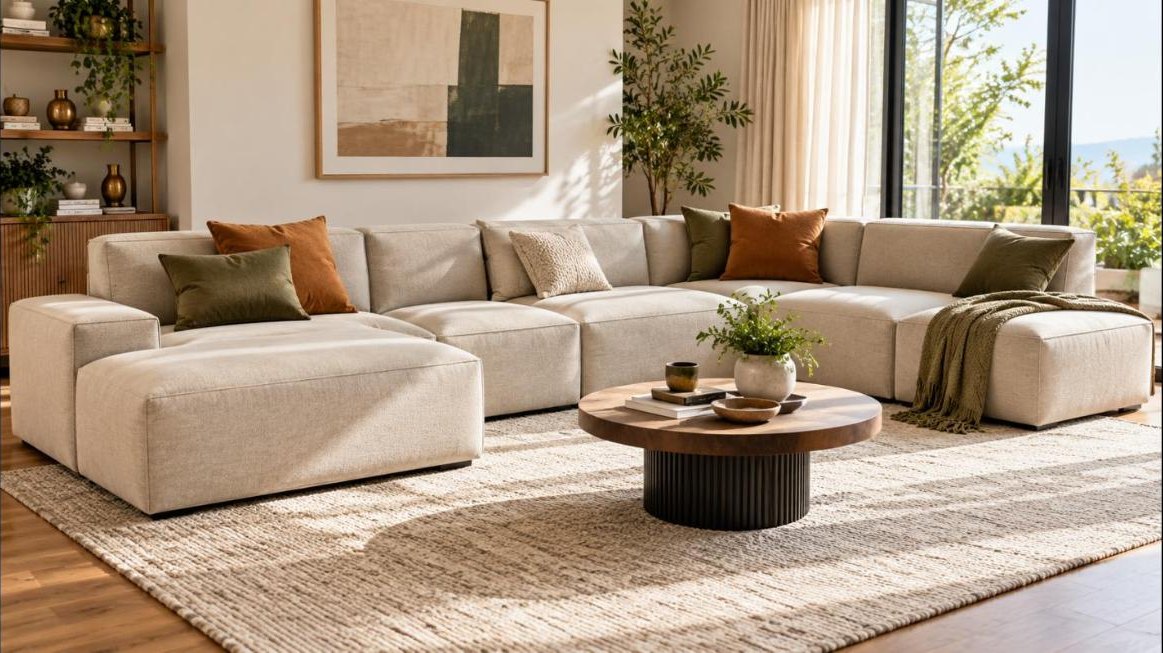
Custom furniture sounds like a luxury decision. Often it is a practical one. If your room has an unusual shape, a non-standard wall length or a door in an inconvenient place, a made-to-order or modular sofa can be the only thing that fits properly, and the premium over a good retail sofa is smaller than most people expect.
What custom actually means
The word covers three quite different levels.
Configured. You pick from a fixed menu: size, arm style, leg finish, cushion fill and fabric, all from the manufacturer’s options. Lead time is typically six to twelve weeks and the premium over a stock version is usually 10 to 25 percent.
Semi-custom. The frame can be altered in specified ways, such as a non-standard length, a deeper seat or a lower back. Lead time runs eight to sixteen weeks, premium around 25 to 50 percent.
Fully bespoke. A workshop builds to your drawing. Twelve to twenty weeks and often double a comparable retail price or more.
Most people who think they need bespoke actually need configured, and the cost difference between those two is large.
When custom is worth it
- A wall that is between standard sizes. A 94 inch wall takes an 84 inch sofa with awkward gaps or a 96 inch sofa that does not fit. A made-to-measure 90 inch solves it.
- A body that standard seats do not suit. Seat depth and height are the two dimensions most worth customising, and most manufacturers will change them for a modest fee.
- A difficult delivery path. Many workshops will build a sofa in sections or with a removable back specifically for a narrow stair.
- A long-term purchase. If you intend to keep the sofa fifteen years, the premium amortises to very little, and workshop-built frames are usually far better than retail ones.
- A fabric you already own or love. Customer’s own material is standard practice in the trade and often cheaper than the maker’s premium fabrics.
When it is not worth it
If a stock sofa fits your room and your body, paying a premium for a slightly different leg finish is spending money on nothing. If you move frequently, a custom sofa sized to one room is a liability. And if the budget is tight, a well-specified stock sofa beats a cheaply made custom one every time; the word custom guarantees nothing about frame or foam quality.
Modular systems: the other route
A modular sofa ships as individual seats, corners and ottomans that connect. It solves many of the same problems as custom, with real advantages.
You can configure it to your room now and reconfigure after a move. You can buy three seats today and add a fourth next year. Delivery is easy because each module fits through a normal door. And if one seat is damaged, you replace that seat rather than the sofa.
The trade-offs are visible seams between modules, a tendency for pieces to separate on hard floors unless the connectors are solid metal brackets, and a generally more casual look. Modular sofas also tend to be deeper than traditional ones, which matters in a narrow room.
Questions to ask any custom maker
- What is the frame material and how are the joints made?
- What is the foam density, and what is the wrap?
- Is the suspension eight-way hand-tied, sinuous springs or webbing?
- Are cushion covers zippered and removable?
- Can I buy replacement covers in five years?
- What is the realistic lead time, and what happens if it slips?
- What is the deposit, and is it refundable before production starts?
- Will you supply a cutting of the final fabric before cutting the full roll?
The deposit question matters. Custom orders typically require 50 percent up front and are non-refundable once production begins, because the piece cannot be resold. Get the point of no return defined in writing.
Managing the lead time
Twelve weeks is a long time without a sofa. Order before you need it, keep the old one until the new one is in the room, and confirm the delivery window at the six-week point rather than waiting. Ask whether the maker will store the finished piece if your schedule slips; most will for a short period.
A realistic recommendation
For most people with an awkward room, the best value sits in the configured tier from a mainstream manufacturer, or in a good modular system. Both solve the fit problem at a sensible price. Reserve fully bespoke for a piece you genuinely intend to keep for decades, or for a room where nothing else will physically work, and in that case spend the money on the frame and the foam rather than on the fabric, because the fabric is the one thing you can change later.

Written by gautam995576@gmail.com
Furniture buying editor focused on practical room planning, material checks, and clear decision guidance.
Related furniture guides
Sofa Colour Trends 2026: What Is Actually Selling
The palettes gaining ground this year, which are durable choices and which are short-lived, and how to use a trend colour without…
Blue Sofas: The Safe Bold Choice
Navy, teal, dusty blue and cobalt behave very differently in a room. How to pick the right shade for your light, and…
Sofa Clearance Sales: Timing, Real Discounts and Red Flags
When furniture actually goes on sale, how to tell a genuine clearance from an inflated list price, and the terms that make…
One comment