Bedroom Seating: Sofa and Chair Ideas That Actually Fit
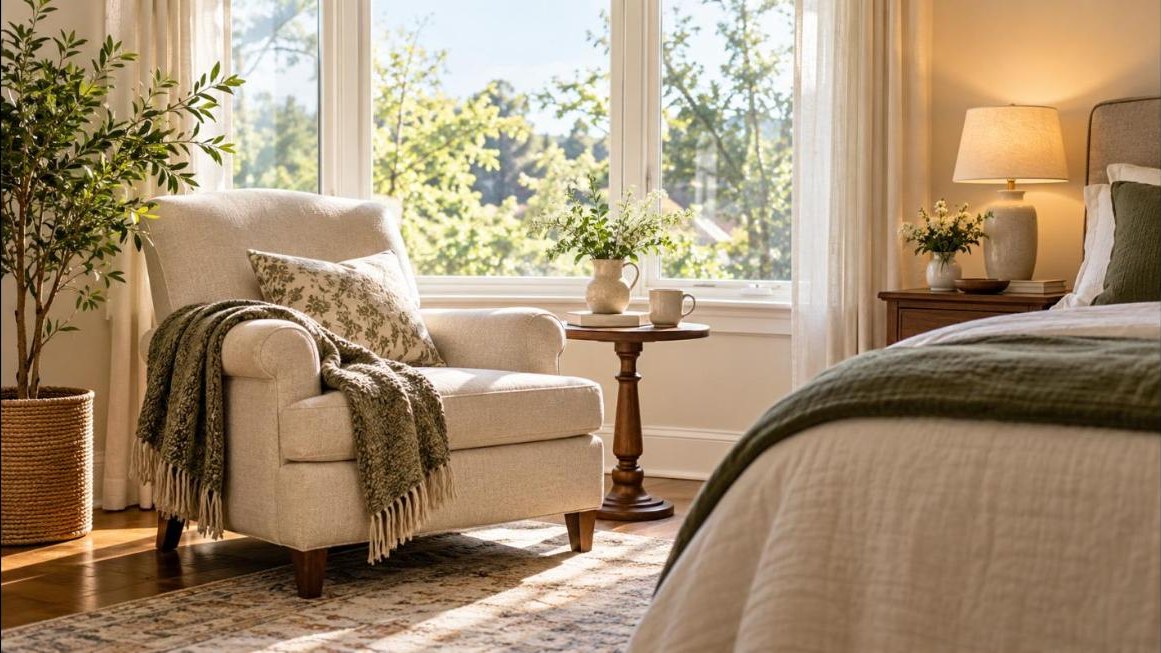
Bedroom seating works when it leaves 75 cm (30 in) of clear walkway around the bed and has a reason to be there: somewhere to put shoes on, to read, or to drop tomorrow’s clothes. In practice that means a bench of 40 to 45 cm depth at the foot of the bed, a single armchair of 70 to 85 cm width in a corner with a lamp, or a loveseat of 130 to 150 cm only if the room is more than about 4 by 4.5 m. Measure the walkway first and buy the seat that fits what is left.
Bedroom seating by room size
| Room size | What fits | Typical dimensions | Clearance to keep |
|---|---|---|---|
| Under 3 by 3.5 m | Stool or small ottoman; wall-mounted fold-down seat | 40 to 50 cm square | 75 cm beside the bed |
| 3 by 3.5 m to 3.5 by 4 m | End-of-bed bench, or one slipper chair | Bench 120 to 150 cm wide, 40 to 45 cm deep; chair 60 to 70 cm wide | 60 cm between bench and wall or wardrobe doors |
| 3.5 by 4 m to 4 by 4.5 m | Armchair with side table and lamp | Chair 70 to 85 cm wide, 80 to 90 cm deep | 90 cm in front of wardrobes with hinged doors |
| Over 4 by 4.5 m | Loveseat, chaise, or two chairs and a table | Loveseat 130 to 150 cm; chaise 150 to 170 cm long | 75 cm walkway on all used routes |
| Bay window | Built-in window seat | 45 to 50 cm deep, 45 cm high | None lost from the floor |
A bench at the foot of the bed should be 10 to 20 cm narrower than the mattress and no higher than it. Storage benches and ottomans do double duty, see bedroom storage ideas; for making a tight room work at all, small bedroom ideas.
Does your bedroom have room for seating?
Run the clearances first. You need 30 inches on at least one side of the bed as the main route, 24 inches on the other sides if they are used, 36 inches in front of a wardrobe with hinged doors and 24 inches in front of sliding ones, and enough space in front of a chest of drawers to open a drawer fully and stand there.
Whatever remains after those is available. If it is less than about 30 by 30 inches, you do not have room for a chair, and forcing one in will make the room feel cramped. A wall-mounted shelf or a slim bench at the foot of the bed is the better answer.
Options by footprint
Under 20 inches deep: a bench. A bench at the foot of the bed is the most space-efficient seating in a bedroom. It gives you somewhere to sit to put shoes on, a surface for a folded throw, and often storage inside. Size it to roughly the width of the bed or slightly less.
Around 24 by 24 inches: a slipper chair or a small armless chair. No arms means a smaller footprint and a lighter look. Good in a corner next to a window.
Around 30 by 32 inches: an accent chair with arms. The classic bedroom chair. Comfortable enough to read in, and it needs a side table and a light to be genuinely used.
Around 34 by 38 inches: an armchair and ottoman. A proper reading seat. Only viable in a larger bedroom, but it transforms how the room is used.
60 to 72 inches wide: a loveseat or settee. Needs a main bedroom with a clear wall. Place it at the foot of the bed facing away, or under a window.
A chaise. Elegant, generous in footprint, and in most homes the piece most likely to become a clothes rack. Only worth it if you will actually lie on it.
Give the seat a reason to exist
A chair becomes a laundry pile when it has no function. Three things prevent it.
Light. A floor lamp or wall light beside the chair makes it a reading seat rather than a decoration. This is the single most effective change.
A surface. A small side table for a cup, a book and a phone. Without one, nobody sits there for long.
Somewhere else for the clothes. A valet stand, a hook rail or an open basket. The pile forms because there is no alternative, not because the chair invites it.
Placement
By a window is the natural first choice, since it gives light and a view. In a corner at an angle softens a boxy room and fills dead space. At the foot of the bed suits a bench or a loveseat, and creates a sense of a separate zone in a larger room. Beside a wardrobe is practical for dressing but visually awkward unless the chair is slim.
What rarely works is a chair pushed against the only clear wall opposite the bed, where it reads as a waiting area.
Comfort and fabric
Bedroom seating takes light use, so you can prioritise comfort and texture over durability. This is the right place for velvet, bouclé or linen that would be impractical in a living room. Keep the seat height around 18 inches so it is easy to rise from, and if the chair is for reading, make sure the back is high enough to support your head.
Choose a fabric that contrasts with the bedding rather than matching it. A chair upholstered in the same fabric as the headboard disappears.
Storage seating
In a small bedroom, make the seat work twice. An ottoman bench with a lift lid holds spare bedding. A storage bench at the foot of the bed takes out-of-season clothes. A window seat built over a low radiator cover or into an alcove gains seating without losing any floor at all, and is often the best use of an awkward bay.
A simple recommendation by room size
Under 110 square feet: a bench or nothing. 110 to 150 square feet: a slipper chair with a small table and a wall light. 150 to 200 square feet: an armchair and ottoman by the window. Over 200 square feet: a loveseat or a proper reading corner with two chairs. In every case, add the lamp and the table at the same time as the seat, because a chair without them will be a chair nobody sits in.
When this does not apply
If wardrobe doors, drawers or a door swing need the space, seating loses; a chair you have to move to open a drawer becomes a clothes pile within a week.
Related guides
- Sofa Dimensions Guide: Measuring Properly Before You Buy
- Narrow-Depth Sofas for Tight Spaces: What to Look For
- How to Choose a Sofa for Your Space and the Way You Live

Written by gautam995576@gmail.com
Furniture buying editor focused on practical room planning, material checks, and clear decision guidance.
Related furniture guides
Multi-Functional Furniture That Actually Earns Its Space
Which double-duty furniture is genuinely useful and which is a gimmick? An honest look at sofa beds, storage pieces, and convertibles for…
Narrow-Depth Sofas for Tight Spaces: What to Look For
Sofas under 33 inches deep solve apartment layouts, but only if the seat depth and back angle are right. Here is how…
Storage Beds vs Standard Beds: An Honest, Real-World Comparison
Storage beds free up space but aren't for everyone. A real-world comparison of storage and standard beds to help you decide which…